High-Resolution Weather Risk Assessment for Seasonal to Decadal Planning
Led by Weiming Hu (University of Georgia), Liyin He (Duke University), David Fastovich (University of Georgia), Andrew Grundstein (University of Georgia), Marshall Shepherd (University of Georgia), Yi Deng (Georgia Tech)
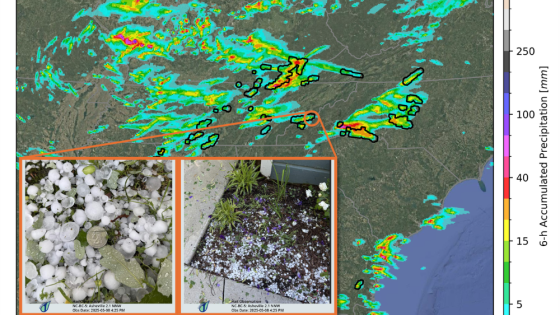
Severe storms that produce hail, wind gusts, and tornadoes can potentially be more costly than anticipated: in recent years over $45 billion annually in actual claims versus $10-20 billion predicted by current models. This gap exists partly because storm forecasts operate at limited resolution (up to 60 miles), which makes them challenging for accurate risk assessment at smaller scales like individual car dealerships. Additionally, while models may aggregate perils, they may not fully capture how storm hazards compound across regions or amplify each other over time.
Our two-year project addresses these problems through three parallel efforts: building a comprehensive map of how storm hazards compound across the United States, developing an index to identify where infrastructure is most vulnerable to multiple simultaneous hazards, and training advanced AI models to produce storm predictions at a higher spatial resolution (~ 2.5 miles). We will combine these tools to reveal how different storm hazards are connected over time and whether they amplify each other in ways that could dramatically increase losses. The final deliverables will provide stakeholders with more spatially detailed risk maps and a deeper understanding and robust assessment of compound storm risks.